Here is an uncomfortable fact about dental implants in the UK: implant surgery is not a recognised specialty on the General Dental Council register. Any dentist may legally place implants after a short course — a weekend, in some cases. Most are conscientious and work within their limits. But the gap between the shortest route into implant dentistry and the longest one is measured in years of supervised training, and the patient searching for an 'implant dentist near me' has no easy way to see it. Every website says experienced. Every website says advanced. So let me give you the map I would use if I were choosing an implant surgeon in London for someone I love.
Ask about the training, specifically
Not 'are you experienced?' — everyone says yes. Ask: where did you train in implant dentistry, and for how long? There is a hierarchy of answers. A postgraduate master's degree in implant dentistry — mine is from the University of Warwick — means years of assessed academic and clinical work: literature, biomechanics, complications, supervised surgery, examined cases. A diploma or certificate means a structured course of months. A weekend course means a weekend. None of these makes someone good or bad by itself, but you deserve to know which one you are buying. Then ask the volume questions: how many implants do you place a year? How many full-arch cases? How many cases like mine?
And ask the question almost nobody asks: who handles your complications? Implants have excellent success rates — ours runs at 97.6% — but no honest surgeon claims 100%. If the answer to the complications question is 'a colleague I refer to', you have learned something important: you are being offered the surgery, but not the responsibility. The strongest answer is 'I do, and here is how' — because managing peri-implantitis, replacing a failed fixture, or revising someone else's work is precisely where deep training shows.

Ask to see the planning, not just the price
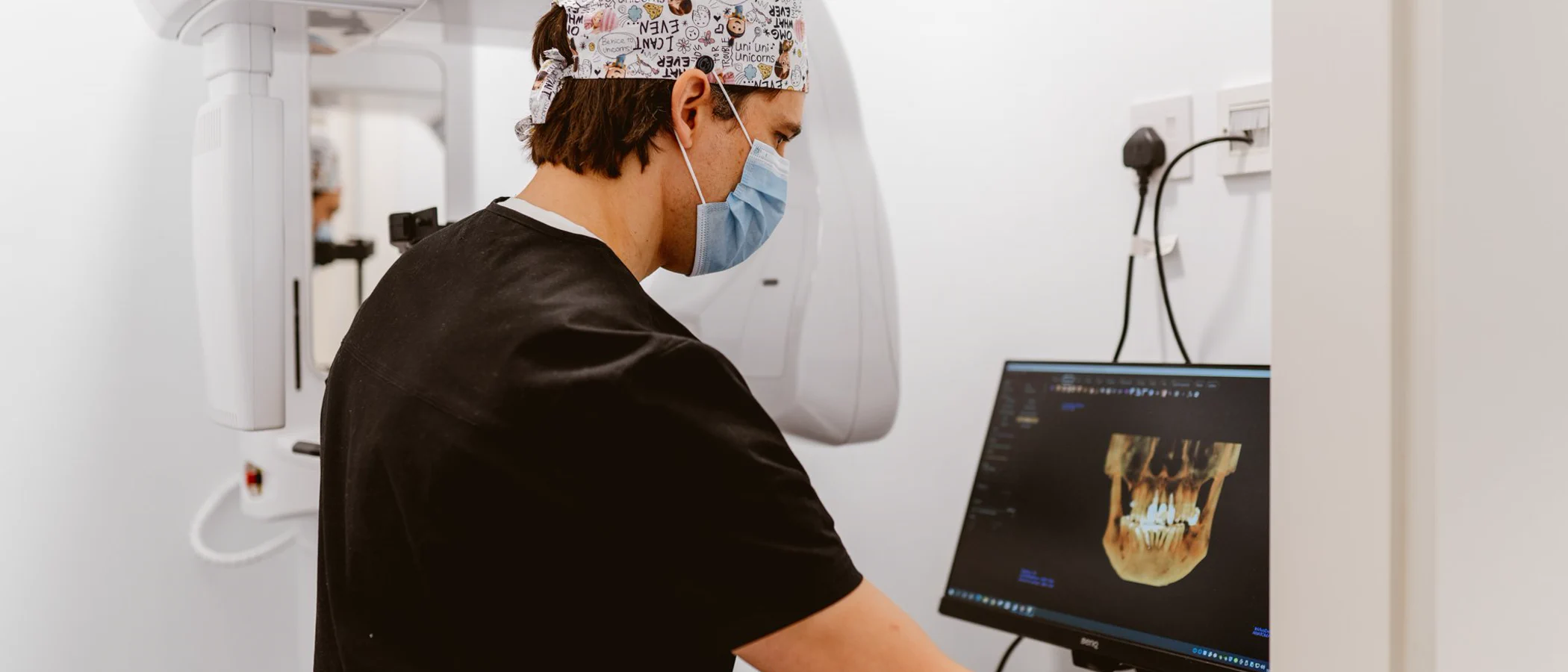
A serious implant clinic will show you your own CBCT scan — the three-dimensional X-ray that maps your jaw — and walk you through it: here is your bone, here is the nerve we are protecting, here is your sinus, this is why the implant goes here and at this angle and not there. This conversation costs the clinic time, which is exactly why it is diagnostic for you: clinics that invest time before you have paid anything tend to be the clinics that invest time after. If the treatment plan arrives as a price list without anatomy — or worse, as a quote generated from photographs alone — be careful. You are being quoted for a product, not a surgery.
On price: dental implant costs in London vary enormously, and a price that seems impossible usually is. Somewhere, something has been removed from the process — the quality of the implant system and its documented long-term evidence, the time allocated to planning, the qualifications of the person doing the surgery, the follow-up — and it is rarely the profit margin. You do not need to buy the most expensive implant in London. You need to understand exactly what your price includes, in writing, including the provisional teeth, the definitive teeth, and what happens if something needs redoing.
Ask what happens after
Implants are not fit-and-forget. They need maintenance — professional hygiene protocols adapted to implants, periodic radiographic review, occlusion checks — like anything load-bearing. Ask what the follow-up schedule looks like, whether the first years of review are included in your fee, and who you call in five years if something feels wrong. The clinics that plan for year five are the ones whose work tends to reach it. At our clinics in Maida Vale and Paddington, follow-up is not an upsell; it is where we protect the statistic we are proudest of.
Choose the surgeon whose refusals you can hear. The one who sometimes says 'no, not yet, not like this' is the one protecting your result.
Finally: trust the consultation itself. Were you listened to, or processed? Were the risks explained without being minimised — nerve position, sinus anatomy, the honest failure rate? Could you repeat your own treatment plan back in your own words afterwards? There is no register that ranks the best implant dentist in London, whatever the advertisements imply. But the quality of that first conversation predicts the quality of everything that follows, and it is a test any patient can run for free.