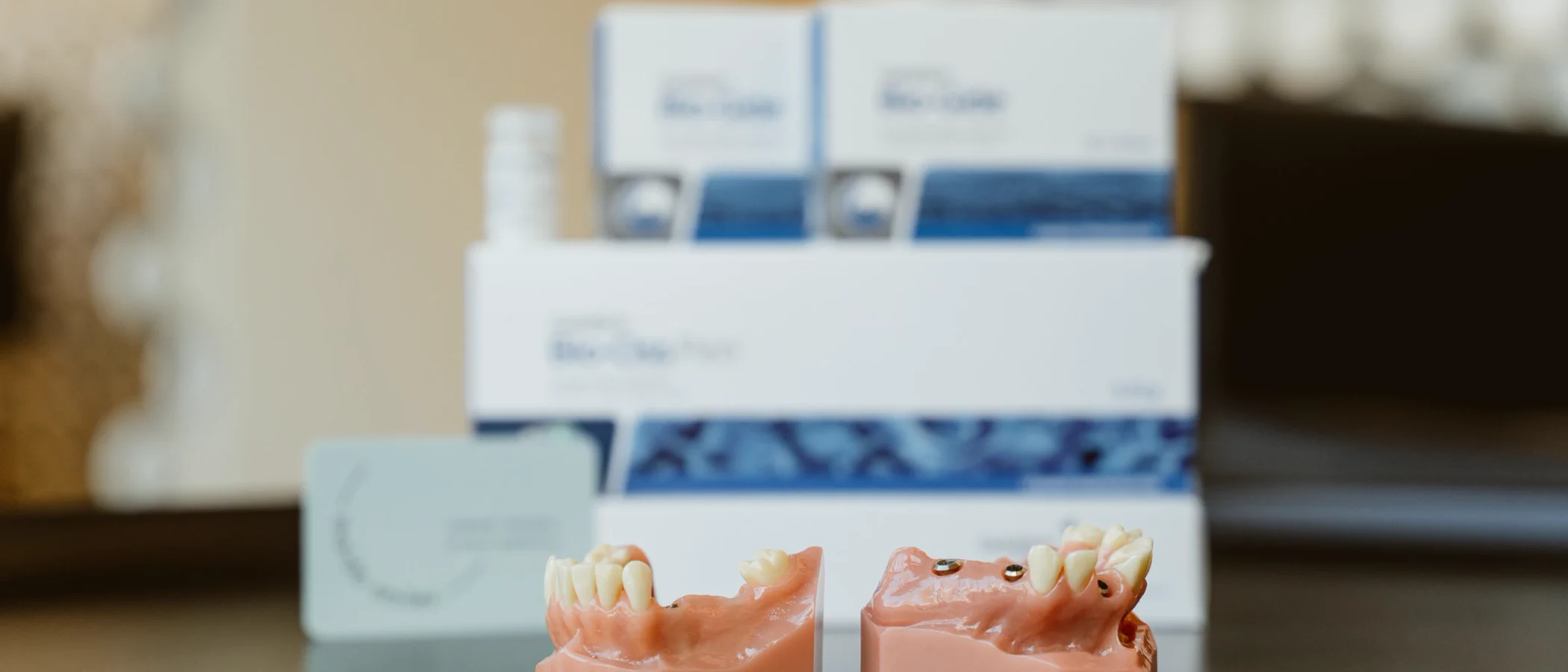
Every month I meet a patient who was told, somewhere else, that dental implants were impossible for them: 'you don't have enough bone.' They arrive at the clinic resigned, expecting me to confirm the verdict — many have already priced up a lifetime of dentures in their heads. Usually I cannot confirm it, because in modern implant dentistry missing bone is rarely a verdict. It is a finding. And findings have treatments.
Why jaw bone disappears
Bone is honest tissue: it stays where it is used and leaves where it is not. Teeth transmit chewing forces into the jaw with every meal, and that stimulation is what tells the bone to maintain itself. When a tooth is lost, the signal stops, and the bone that held it begins to resorb within months — the ridge can lose a substantial share of its width in the first year alone. Wait a decade, and the ridge that once anchored a molar can thin to a knife edge; in the upper jaw, the sinus expands downwards into the space. This is why the 'wait and see' approach to a missing tooth quietly forecloses options: the seeing gets worse the longer the waiting lasts, and the eventual implant treatment gets bigger, longer and more expensive.
The regenerative toolkit answers most of these situations. Guided bone regeneration rebuilds width using graft material protected under a membrane while the body replaces it with living bone. A sinus lift creates vertical height in the back of the upper jaw — one of the most common procedures we plan for London patients who lost molars years ago. Focal defects can be reconstructed with ring or block grafts. In Nice I trained in Professor Choukroun's platelet-rich fibrin protocols, and later in the S-PRF 'sticky bone' technique — and this is the part patients find genuinely surprising.
Your own blood is the technology
At the start of surgery we draw a small amount of the patient's blood — the same as a routine blood test — and centrifuge it in a precise protocol. What separates out is a fibrin matrix dense with platelets, leucocytes and growth factors: the body's own healing signal, concentrated into a membrane we can handle surgically. Combined with bone graft particles, it forms a stable, mouldable, biologically active scaffold — the 'sticky bone' — that recruits the patient's own cells to do the rebuilding. It improves handling for the surgeon and early healing for the patient, and it is completely autologous: nothing in it is foreign. No pharmaceutical achieves this more elegantly, because it is not an imitation of biology. It is biology, redirected.
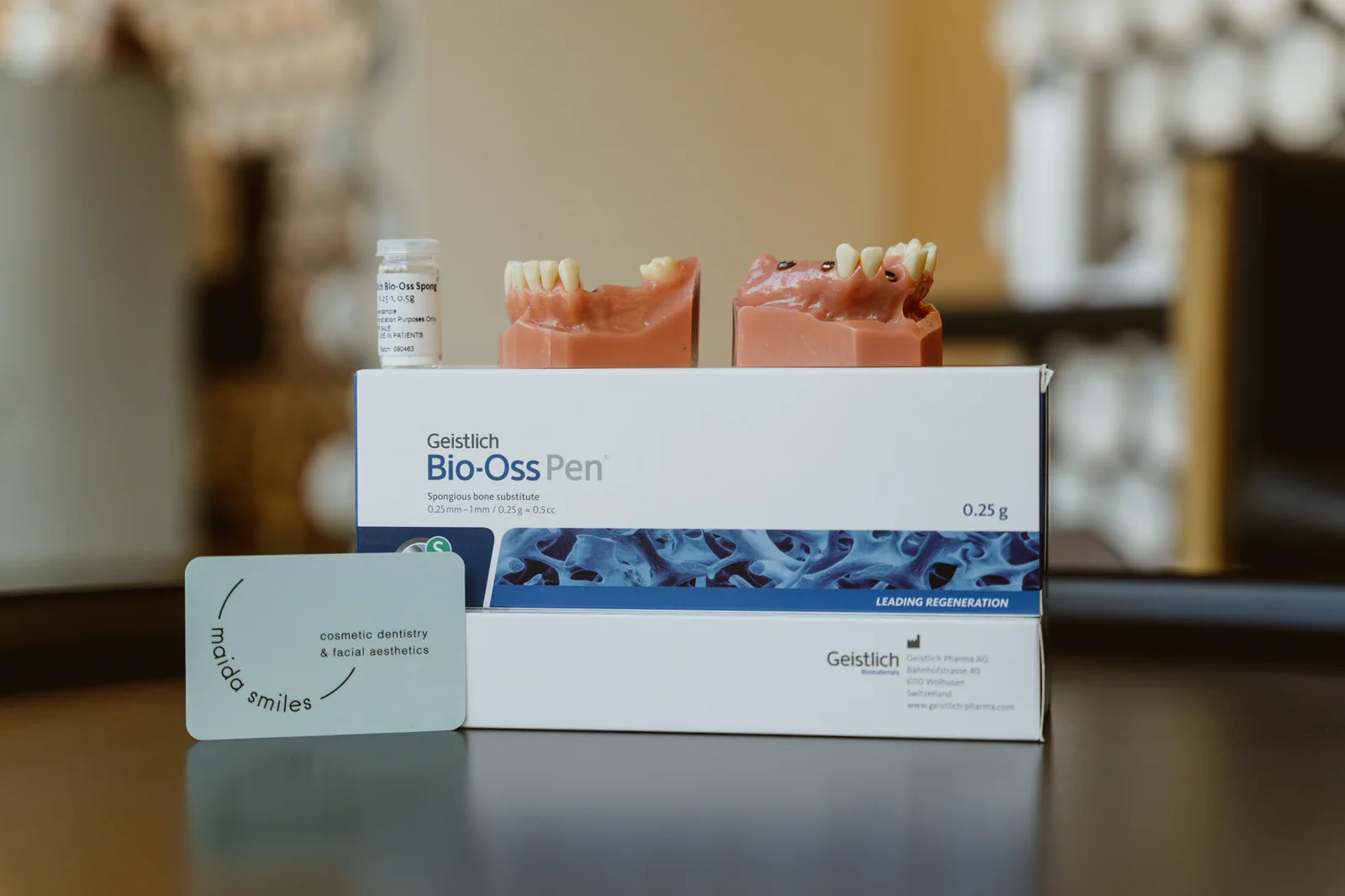
'Not enough bone' usually means 'not enough bone yet.' The foundation can be rebuilt — and then the house can be built on it.
Regeneration adds time to a treatment plan — weeks or months of quiet biological work before the implant ever appears, occasionally staged across more than one procedure. Patients sometimes ask if we can skip it, and I give them the engineer's answer: you can always build faster on a bad foundation; you just cannot keep the building. If you have been told you are 'not suitable for dental implants' because of bone loss, the useful next step is a CBCT scan and a second opinion from an implant surgeon who regenerates bone routinely. The patients who wait for the biology are the ones whose implants I expect to review, uneventfully, in twenty years.